



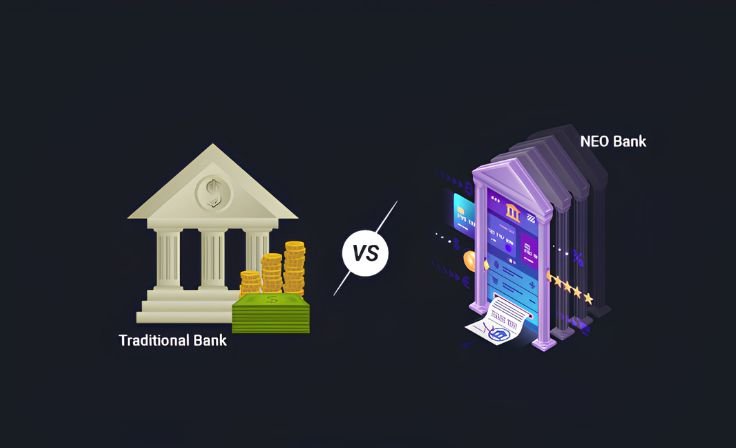

For over a century, the banking world was a closed loop. You picked a bank because your parents used it, or because there was a branch on the corner of your street. These Traditional Banks were built on “Old Debt”—mortgages, commercial loans, and physical infrastructure.
Then came the Neobanks. Built on “New Data,” these digital-native challengers stripped away the buildings and the bureaucracy to focus on one thing: the user’s financial growth.
1. Neobanks: The Growth Engines of 2026
Neobanks (like Chime, Revolut, or Monzo) don’t see themselves as storage units for cash. They see themselves as financial performance tools. Because they don’t have thousands of physical branches to heat, light, and staff, they pass those massive savings directly to you.
The High-Yield Advantage
In 2026, the gap has widened. While a traditional “Big Four” bank might offer you a measly 0.01% interest on your savings, Neobanks are consistently offering 4% to 5% APY.
- The Math: On a $10,000 emergency fund, a traditional bank gives you $1 a year. A Neobank gives you $500. That’s not just a difference in interest; that’s a different lifestyle.
“Bucket” Budgeting & Instant Sub-Accounts
Neobanks pioneered the “Envelope Method” for the digital age. You can create instant sub-accounts for “Rent,” “Travel,” or “New Car.”
- The Psychology: When your money is partitioned, you are less likely to spend your rent money on a night out. It creates “mental friction” that protects your savings.
AI-Driven Spending Insights
Your Neobank app in 2026 is essentially a personal accountant. It uses AI to track your recurring subscriptions, predict your end-of-month balance, and even nudge you: “Hey, you’ve spent 20% more on dining out this week than usual. Want to move $50 to your ‘Investment’ bucket instead?”
2. Traditional Banks: The Anchors of Stability
Traditional banks (JPMorgan Chase, HSBC, Bank of America) aren’t obsolete, but their role has shifted. They are the “Anchors.” They offer deep stability, complex regulatory compliance, and a suite of products that Neobanks often struggle to match.
The Complexity of “Big” Life Events
If you are looking for a 30-year fixed mortgage, a complex commercial loan for a new business, or a safe deposit box for physical heirlooms, the traditional bank is still king. They have the balance sheets to handle massive, long-term debt.
The “Human” Safety Net
While AI is great, sometimes you want to sit across a desk from a human being when a transaction goes wrong or when you are planning a massive estate transfer. Traditional banks provide a level of “high-touch” service that digital apps can’t yet replicate for high-net-worth individuals.
The Verdict: The Lucky Frog Strategy
So, which one helps you grow? The answer is in the Leap.
If you are in the “Wealth-Building” phase—meaning you are under 40, focused on saving, investing, and maximizing every dollar—Neobanks are your primary weapon. They offer the agility, the interest rates, and the tech tools you need to build your foundation.
The Hybrid Approach for 2026:
- Primary Account (Neobank): Use this for your paycheck, your daily spending, and your high-yield “Wealth” buckets. Let the AI manage your habits.
- Secondary Account (Traditional): Keep a small relationship here for the long term. Use it for your credit history and eventually your mortgage or large-scale business loans.
Final Thought: Don’t Let Your Money Sleep
Traditional banks are built to keep your money safe. Neobanks are built to keep your money moving. At Lucky Frog, we want you to move. In 2026, “safe” is no longer enough. You need a partner that helps you grow, nudges you toward better habits, and pays you a fair price for your deposits.
Stop being a customer of the past. Start being an investor in your own future.